

Best Orthodontic Wire Manufacturers 2026: Top Suppliers
Table of Contents
- What Separates the Best Orthodontic Wire Manufacturers in 2026
- Orthodontic Archwire Manufacturers: What to Look For
- Stainless Steel Orthodontic Archwire: Strengths and Trade-Offs
- Orthodontic Archwire Types and When Each One Fits
- How to Choose Orthodontic Archwires for Your Practice
- Pricing, Minimum Order Quantities, and Lead Times
- Quality Control, Certifications, and Counterfeit Risk
- Frequently Asked Questions
Last Updated: October 8, 2026
What Separates the Best Orthodontic Wire Manufacturers in 2026
Choosing the best orthodontic wire manufacturers 2026 comes down to four things: documented quality control, consistent wire dimensions, realistic lead times, and a verifiable supply chain. Everything else is marketing.
A wire that meets its stated dimensions delivers predictable force; one that doesn't can stall alignment or overcorrect in finishing.
Below, we break down how to evaluate an archwire manufacturer, what to look for by wire type, and how to build a supply chain that doesn't leave a chair empty mid-week.
Selection Criteria Buyers Should Apply
Most practices pick a wire supplier the way they picked their last one: price first, everything else later. That works until a shipment arrives with inconsistent arch form or a coating that flakes during placement.
A more useful approach scores suppliers across five areas:
- Quality standards: Documented quality control at each production stage, not just a final inspection
- Product consistency: Wire dimensions and tensile strength that hold steady batch to batch
- Certifications: Recognized quality certifications and regulatory approvals you can verify
The criteria that matter most shift with your practice. A two-chair clinic cares about order flexibility and fast restock. A multi-location group cares about batch consistency across every site, because a wire that behaves differently by location creates clinical variation you can't easily trace.
Orthodontic Archwire Manufacturers: What to Look For
An orthodontic archwire manufacturer is a specialized producer that draws, forms, and finishes wire to specific alloy, dimension, and arch form specifications for clinical use.
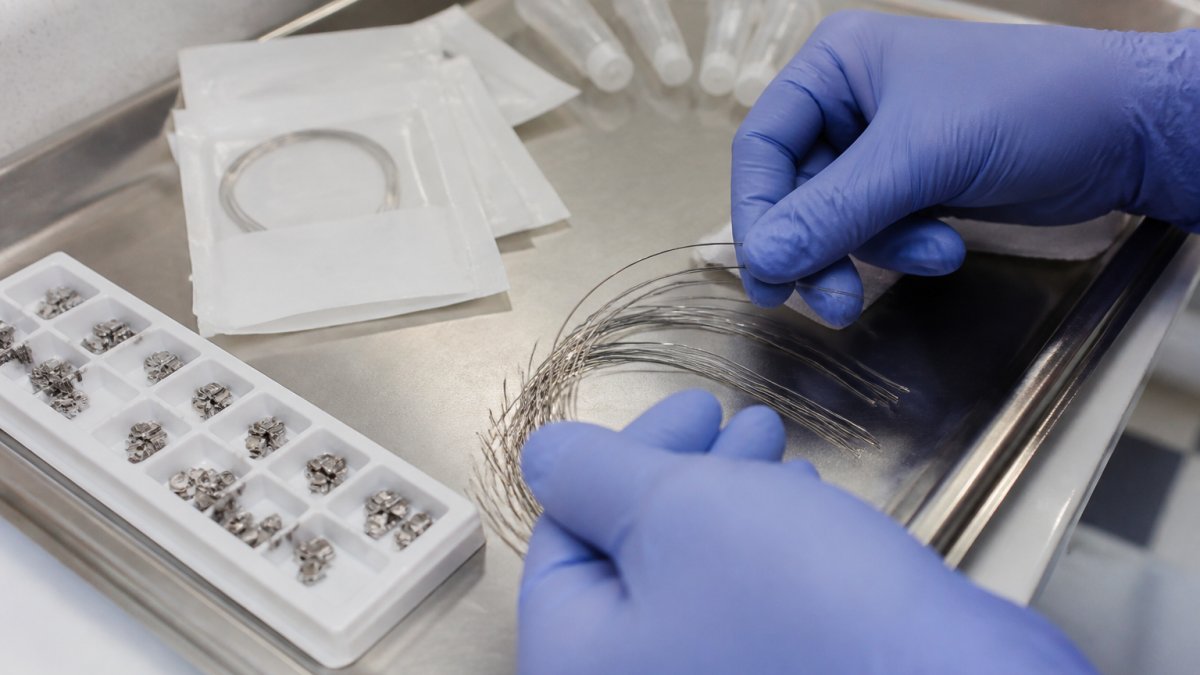
What separates a strong manufacturer from an average one is process control. Drawing, heat treatment, and forming each affect how a wire behaves in the mouth.
A common mistake is judging a manufacturer on catalog breadth alone.
Stainless Steel Orthodontic Archwire: Strengths and Trade-Offs
Stainless steel orthodontic archwire remains the workhorse of fixed appliance treatment, offering high tensile strength, good formability, and reliable force delivery.
Its strengths are practical:
- Formability: Bends and holds shape, which matters in finishing and detailing
- Tensile strength: Handles the forces of active treatment without deforming
- Cost efficiency: Generally the most economical wire material for high-volume use
The trade-offs are equally real. Stainless steel has limited elasticity compared with nickel-titanium, so it isn't right for the earliest alignment phase, and it can require more frequent adjustments.
Coated and uncoated options add another decision layer. Uncoated archwire offers direct surface contact and predictable friction. Coated archwire improves esthetics, but coating durability varies by manufacturer, a coating that wears or flakes mid-treatment creates both a clinical and a patient-satisfaction problem.
Orthodontic Archwire Types and When Each One Fits
Orthodontic archwire types map to treatment stages because of material science: each alloy delivers force differently, and that difference, not brand or price, determines which stage it belongs in.
| Wire Type | Typical Alloy / Construction | Best Treatment Stage | Force Character | Formability | Main Trade-Off |
|---|---|---|---|---|---|
| Nickel-titanium (NiTi) | Near-equiatomic nickel-titanium | Initial alignment and leveling | Light, continuous, superelastic | Very low, springs back | Cannot be bent to a new shape |
| Stainless steel | Iron-chromium-nickel (e.g., 302/304-type) | Finishing and detailing | Higher, more constant | High, holds bends and loops | Limited elastic range |
| Beta-titanium (TMA-type) | Titanium-molybdenum alloy | Intermediate and finishing | Moderate, controllable | Good, bends without fracturing | Higher material cost |
| Coated esthetic | NiTi or stainless core with polymer coating | Any stage needing esthetics | Depends on core wire | Depends on core wire | Coating adhesion varies by maker |
| Multi-strand | Twisted or braided stainless strands | Initial alignment | Very light and flexible | Moderate | Harder to clean; food traps |
Why the stage mapping works
Nickel-titanium delivers a nearly constant force across a wide activation range, the superelastic effect.
Stainless steel has a much smaller elastic range but far greater stiffness and formability.
Multi-strand wire is built from several thin stainless strands twisted or braided together, producing a very flexible, low-force wire that can be tied into severely malpositioned brackets.
Coated wire is a core wire (usually NiTi or stainless) with a tooth-colored polymer coating.
Dimensional conventions you will see on every spec sheet
Archwire is sized in thousandths of an inch, written as two numbers separated by a multiplication sign, for example, 0.014 or 0.016 for round wire, and 0.016 × 0.022 or 0.019 × 0.025 for rectangular wire. Rectangular wire engages the bracket slot in three dimensions, which allows torque and tip to be expressed. (Source: market research on orthodontic supplies)
A common progression is round NiTi for alignment, then rectangular NiTi or beta-titanium, then rectangular stainless for finishing. The exact sequence depends on the bracket system and case, but the direction, light and round to stiff and rectangular, is universal.
The practical rule: start light and flexible, finish strong and formable.
How to Choose Orthodontic Archwires for Your Practice
Knowing how to choose orthodontic archwires comes down to matching three variables: treatment stage, patient case mix, and your ordering reality.
Work through it in this order:
- Map your case mix. Note how many cases sit in initial alignment versus finishing. That ratio tells you which wire types you actually burn through.
- Match wire to stage. Use elastic wires for alignment and formable wires for detailing. Don't substitute one for the other to save money.
- Check dimensional consistency. Confirm the manufacturer holds stated wire dimensions and arch form batch to batch.
- Verify the supply chain. Confirm lead times, minimum order quantities, and whether the supplier holds backup stock.
- Confirm documentation. Ask for certifications and lot-level quality records before you commit to volume.
- Test before scaling. Run a small order through your normal workflow before making it your primary source.
The step most practices skip is number six. A wire that performs well in a sample may behave differently across a full month of cases. Ordering a small quantity first costs little and prevents a costly inventory mistake.
Pricing, Minimum Order Quantities, and Lead Times
We cannot publish fixed prices, archwire pricing moves with alloy costs, order size, and customization, but we can give you the structure to read a quote intelligently.
What drives the unit price
Four variables explain almost all of the spread between quotes:
- Alloy. Nickel-titanium and beta-titanium cost more per unit than stainless steel because the raw materials and the drawing/heat-treatment processes are more demanding. Stainless is the least expensive of the three main alloys.
- Form. Preformed archwires (with a shaped arch form and often with torque and tip built in) cost more than straight-length wire you form yourself. Preformed saves chair time; straight wire saves unit cost.
- Coating. Esthetic coated wire carries a premium over the same core wire uncoated, because the coating is an extra production step and a quality-control risk.
- Order size. Unit price falls as quantity rises, but the curve flattens. The biggest discount is usually between a single pack and a case quantity; beyond that, the savings per unit shrink.
Minimum order quantities
MOQ is where small practices get squeezed. A low MOQ keeps a two-chair clinic from tying up cash in inventory it won't use for months.
A practical pattern: ask each supplier for their MOQ at three levels, per SKU, per order, and per year (if they have an annual commitment). Suppliers who only quote an annual commitment are usually optimizing for their own production planning, not your cash flow.
Lead times
Lead time is the second number to check, and often more important than price. A supplier with a slightly higher unit price but reliable two-day restock beats a cheaper supplier with unpredictable delivery every time, empty chairs cost more than wire.
Ask for two lead-time figures, not one:
- Standard lead time for stock items
- Custom lead time for made-to-specification arch forms or dimensions
Custom wire can add days to weeks depending on the manufacturer's production schedule. If your practice relies on a specific arch form, confirm the custom lead time before you commit, not after.
Customization
If your practice needs specific arch forms, dimensions, or torque/tip values, confirm three things before ordering:
- Whether the manufacturer can produce to your specification at all
- What customization does to MOQ (it usually raises it)
- What customization does to lead time (it usually lengthens it)
How to compare quotes
Do not compare unit price alone. Compare landed cost per case: unit price plus shipping, plus the carrying cost of the MOQ you must buy, plus the expected cost of a stockout if lead times slip.
A useful exercise: take your last three months of wire usage, price it at two or three suppliers' quoted terms, and add a stockout penalty for the supplier with the longest lead time. The cheapest unit price rarely wins.
Quality Control, Certifications, and Counterfeit Risk
Quality control is where the best orthodontic wire manufacturers 2026 separate themselves, and where buyers have the least visibility, exactly where counterfeit and gray-market product enters the supply chain.
Counterfeit orthodontic products are a documented concern across the dental industry, and archwire is not exempt.
Protect your practice with four checks:
- Buy from authorized sources. Traceable distribution is the simplest counterfeit defense.
- Request lot-level documentation. Certificates of analysis per production lot, not per catalog page.
- Verify certifications. Confirm the manufacturer holds recognized quality certifications and can show current documentation.
The FDA guidance on medical device quality systems sets the framework for how device manufacturers document quality control, and it's a useful reference when you're evaluating what a supplier's paperwork should actually contain.
For practices that want to reduce this risk entirely, sourcing from a supplier with a documented, traceable supply chain removes most of the guesswork. That's the approach we take at A2Z Orthodontics: most of our items are made in the USA, keeping the supply chain short and the documentation verifiable.
Frequently Asked Questions
Who are the leading orthodontic wire manufacturers in 2026?
The market includes established global suppliers and smaller specialized producers. Instead of ranking brands, evaluate manufacturers on documented quality systems, material traceability, and consistency of arch form and dimensions. Ask for certification records, sample batches, and references from clinics using the wire daily. A2Z Orthodontics carries a catalog of orthodontic wires and brackets, with most items made in the USA, so practices can source verified products from one supplier rather than managing multiple vendors.
What should orthodontists look for when choosing an archwire manufacturer?
Focus on four things: material certification, dimensional accuracy, surface finish, and supply reliability. Request test reports for tensile strength and elasticity, confirm the wire dimensions match the stated gauge, and check that coatings adhere without flaking. Ask about minimum order quantities, lead times, and whether the manufacturer can scale production for your practice size. Transparent documentation separates reliable suppliers from those that only publish marketing claims.
How do stainless steel and nickel-titanium orthodontic wires differ?
Stainless steel wire offers high tensile strength and formability, which makes it useful for finishing stages and space closure where stiffness is needed. Nickel-titanium wire provides greater elasticity and delivers lighter, more continuous force, which suits initial alignment and leveling. Many practices stock both and switch by treatment stage. The right mix depends on your case load and the archwire types your clinicians prefer for each phase.
What questions should buyers ask an orthodontic wire supplier?
Ask about country of manufacture, quality certifications, batch traceability, minimum order quantity, lead time, and return policy. Confirm the supplier can provide documentation for every shipment to reduce counterfeit or gray-market risk. If your practice runs multiple chairs, ask whether the supplier can consolidate brackets, wires, and patient care items into one order to simplify inventory management.
A reliable wire supply chain isn't about finding the cheapest reel. It's about knowing that every order arrives at the stated dimensions, with documentation you can verify, fast enough to keep every chair running. A2Z Orthodontics supplies a comprehensive catalog of orthodontic materials, including brackets, wires, aligner aids, and patient care items, with most items made in the USA. Get started with A2Z Orthodontics and build a wire supply you don't have to think about.